
They may be related to problems in the venous system, as with venous ulcers, or to an insufficient arterial blood supply, as with arterial ulcers.
When a wound is not healing properly, it is important to identify the cause. A vascular assessment can determine whether a circulation problem is preventing healing and establish the most suitable treatment.
What is a vascular ulcer?
A vascular ulcer is a skin lesion that does not heal properly due, at least in part, to a problem with blood circulation.
Ulcers can appear in different areas of the legs and have different characteristics depending on their origin.
The most common vascular causes are:
- Venous insufficiency
- Peripheral arterial disease
- Previous venous thrombosis
- Arterial blockages
- Microcirculation disorders
- Diabetes associated with vascular disease
Correctly identifying the origin of the ulcer is essential, as treatment can be completely different depending on whether the lesion is venous or arterial.
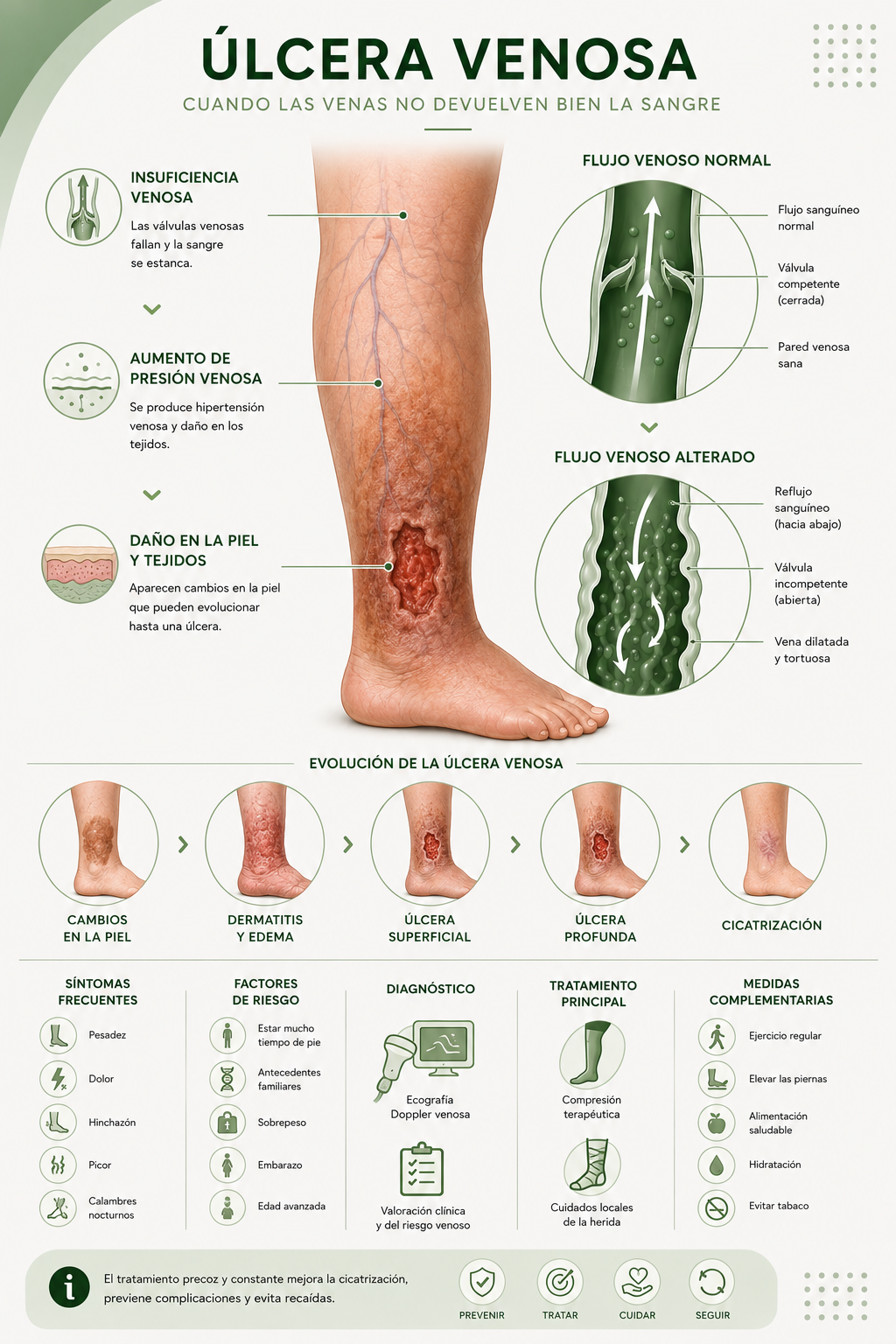
Venous ulcers
Venous ulcers result from impaired return of blood from the legs to the heart.
When the veins do not work properly, pressure within the venous system can increase and cause progressive changes in the skin and tissues.
They usually appear around the ankle and may be accompanied by:
- Leg swelling
- Heaviness
- Varicose veins
- Changes in skin colour
- Hardening of the tissues
- Itching or discomfort
- Wounds that are slow to heal
Arterial ulcers
Arterial ulcers appear when the tissues receive an insufficient blood supply due to arterial disease.
The lack of oxygen makes healing difficult and can cause progressive tissue loss.
They can appear on the toes, the foot, the heel or other areas of the limb.
Some signs that may suggest an arterial origin are:
- Cold foot
- Changes in colour
- Pain, especially at rest
- Pain that may worsen when the leg is raised
- Weak or absent pulses
- Wounds that do not heal
- Necrosis
When circulation is severely reduced, revascularisation may be needed to improve the blood supply and promote healing.
Chronic and non-healing wounds
A wound that stays open for a long time should be assessed to identify which factors are hindering its progress.
Possible causes include:
- Venous insufficiency
- Arterial disease
- Diabetes
- Infection
- Continuous pressure on the area
- Loss of sensation
- Oedema
- Nutritional problems
- Conditions that affect healing
In some patients several causes may coexist.
For this reason, treating a chronic wound should not be limited to dressings alone; it is also important to treat the problem that is preventing healing.
Assessing the circulation
A vascular assessment determines whether blood is reaching the tissues properly and whether there is a problem that could explain the lack of healing.
Depending on the findings, different tests may be carried out.
Arterial and venous Doppler ultrasound
This makes it possible to study both the arterial and the venous circulation. In the arterial system it can detect narrowing or blockages that reduce blood supply.
In the venous system it shows how the veins are working, detects reflux and assesses possible blockages.
It is an essential tool for identifying the vascular origin of a wound.
Other imaging tests
When significant arterial disease is identified and revascularisation is being considered, a CT angiography or other imaging tests may be needed to understand the anatomy of the arteries more precisely.
In patients with complex venous disease, additional tests may also be needed to assess the venous system.
The choice of tests depends on each patient’s characteristics and the information needed to plan treatment.
Treatment of vascular ulcers
Treatment must be adapted to the origin of the ulcer.
For venous ulcers, oedema must be controlled with compression and, when indicated, the venous insufficiency treated.
For arterial ulcers, the main goal is to improve the blood supply to the tissues. Some patients may need endovascular treatment or revascularisation surgery.
Treatment may also include:
- Wound care and protection
- Infection control when present
- Offloading of pressure areas
- Diabetes control
- Treatment of cardiovascular risk factors
- Improving nutritional status when needed
- Monitoring the progress of the lesion
Revascularisation for arterial wounds
When an ulcer is related to a significant lack of arterial circulation, improving blood flow can be key to promoting healing.
Depending on the anatomy and the patient’s characteristics, endovascular techniques, open surgery or a combination of both may be used.
The aim is to get enough blood to the affected area to preserve the tissues and help the wound recover.
An individual approach to complex wounds
Chronic wounds can have different causes, and in many cases more than one factor is hindering healing.
At Berkelium Surgical Group we study each patient’s arterial and venous circulation to determine whether a vascular problem is causing or contributing to the lesion.
Our goal is to identify the cause of the wound and establish the most suitable strategy, from conservative treatment and control of vascular disease to revascularisation when indicated.