
For this reason, when oedema persists it is important to have a proper assessment to identify its origin and establish the most appropriate treatment.
At Berkelium Surgical Group we study each case individually to distinguish between lymphoedema, venous insufficiency and other causes of oedema, and to establish a treatment and follow-up plan tailored to each patient.
Why do legs swell?
Oedema occurs when too much fluid builds up in the tissues.
It can affect one or both legs and may be constant or vary throughout the day.
The most common causes include:
- Venous insufficiency
- Lymphoedema
- Venous thrombosis
- Prolonged immobility
- Certain medications
- Heart, kidney or liver problems
- Blockages in the venous or lymphatic system
Differential diagnosis of leg oedema
Not all oedema has the same origin, and treatment depends on the cause.
During the assessment we look at:
- Whether it affects one or both legs
- When it appears and how it evolves
- Whether it worsens at the end of the day and improves when the legs are raised
- Presence of pain
- Skin changes
- Varicose veins
- History of thrombosis
- Previous surgery or treatments
- Associated conditions
Depending on the findings, imaging tests may be needed, especially a venous Doppler ultrasound, to study the circulation.
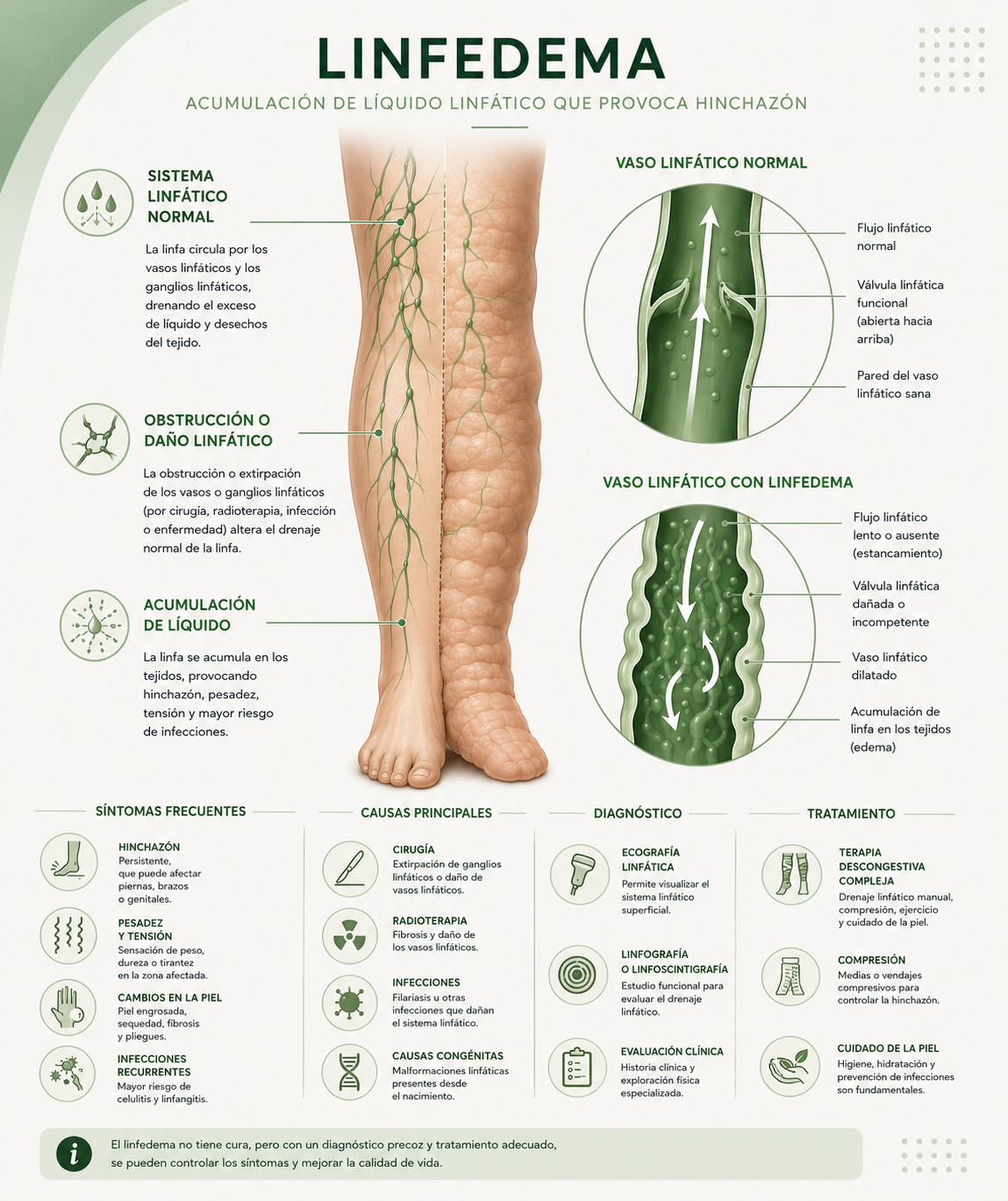
Lymphoedema
Lymphoedema occurs when a problem in the lymphatic system hinders the drainage of fluid from the tissues.
It can be primary, when there is a problem with the lymphatic system itself, or secondary, when it results from other situations such as certain surgeries, cancer treatments, infections or injuries to the lymphatic system.
In the early stages it may be softer and improve partially when the limb is raised. Over time it can cause permanent changes in the tissues.
Venous insufficiency
Venous insufficiency is one of the most common causes of leg swelling.
When the valves in the veins do not work properly, blood can pool in the legs and increase the pressure within the venous system.
Venous Doppler ultrasound shows how the veins are working and detects reflux or blockages that could explain the symptoms.
How is a swollen leg investigated?
The assessment begins with a medical history and a physical examination.
When venous disease is suspected, Doppler ultrasound makes it possible to study:
- Deep and superficial veins
- Presence of thrombosis
- Venous reflux
- Blockages
- Condition of the venous system
In some patients other tests may be needed to study the lymphatic system or rule out non-vascular causes.
The aim is to determine the cause of the oedema before establishing treatment.
Treatment of oedema
Treatment depends on the cause and each patient’s characteristics.
For venous insufficiency, measures such as compression, exercise, leg elevation and specific treatment of varicose veins or venous reflux when indicated may be used.
For lymphoedema, treatment usually focuses on improving lymphatic drainage and controlling the volume of the limb. It may include compression, exercise, skin care and specialised physiotherapy techniques.
When there is a thrombosis or another vascular problem, treatment must be adapted to the specific cause.
Vascular follow-up
Follow-up makes it possible to assess how the swelling evolves and check the response to treatment.
Depending on each patient, clinical check-ups and Doppler ultrasound or other tests may be carried out when indicated.
It is also important to detect changes in symptoms or in the skin that could indicate a complication.
An individual approach to oedema
Leg swelling can have different causes, and sometimes several problems coexist.
At Berkelium Vascular we carry out an individual assessment to determine whether the origin is related to the venous system, the lymphatic system or other causes, and establish the most suitable treatment.
Our goal is to identify the cause of the oedema, relieve symptoms and provide personalised vascular follow-up, adapting treatment as each patient progresses.