
Before starting treatment it is important to assess the venous system to determine the origin of the lesions and rule out venous disease that requires a different type of treatment.
At Berkelium Surgical Group we study each case individually to determine the most suitable technique according to the type, location and characteristics of the lesions.
What are spider veins and reticular veins?
Telangiectasias, or spider veins, are small dilated blood vessels that can be seen under the skin as red, blue or purple lines or small networks.
Reticular veins are larger than telangiectasias, although they are still superficial.
They can appear due to different factors, including:
- Family predisposition
- Age
- Hormonal factors
- Pregnancy
- Standing for long periods
- Overweight
- Venous circulation problems
Prior vascular assessment
Before treating spider veins it is important to carry out a proper assessment.
In some patients a venous Doppler ultrasound may be indicated to study the venous system and rule out venous insufficiency or other problems that could contribute to the appearance of reticular veins.
This assessment allows treatment to be planned more safely and the most suitable technique to be selected.
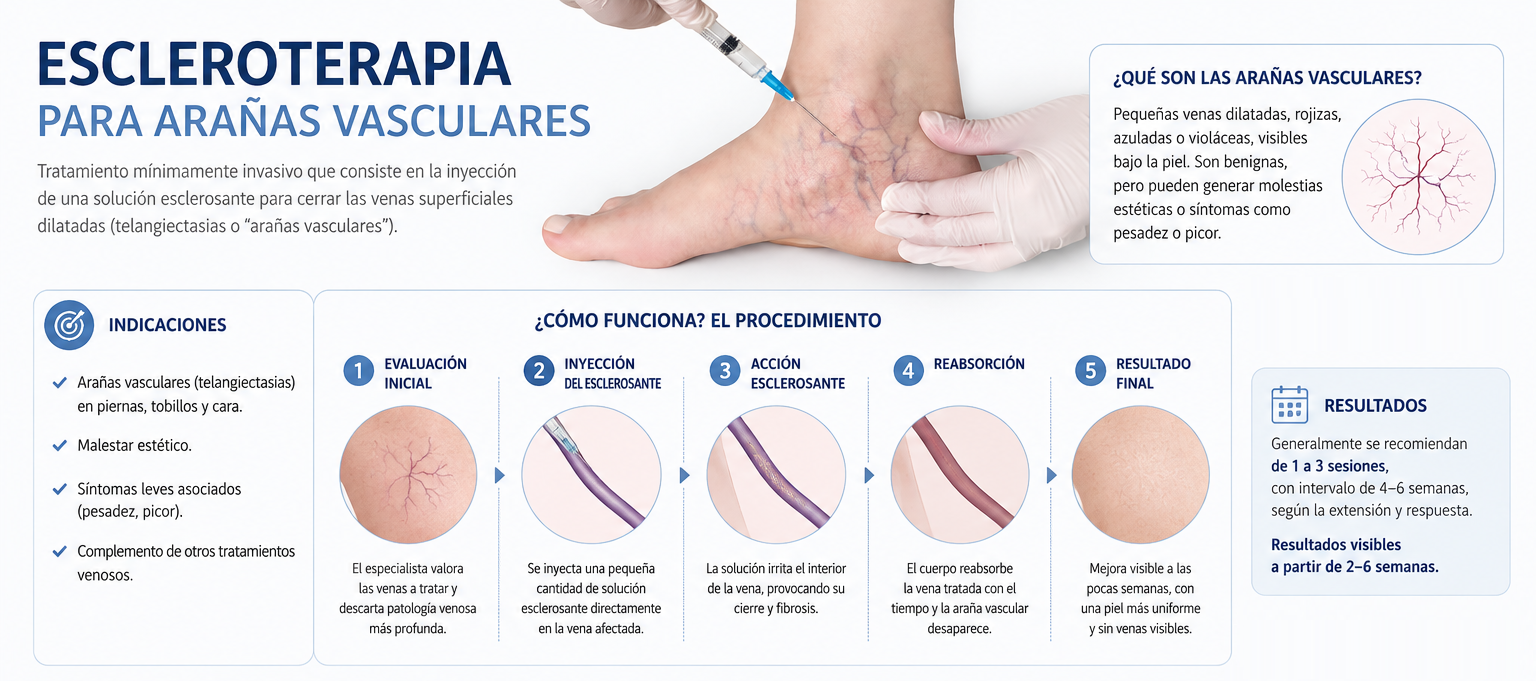
Sclerotherapy for telangiectasias
Sclerotherapy is one of the most widely used techniques for treating certain spider veins and small reticular veins.
It involves injecting a sclerosing substance into the vessel through a very fine needle. The product causes a controlled reaction in the vein wall, so the vein gradually fades away.
It is an outpatient procedure that generally requires neither surgery nor general anaesthetic.
The number of sessions depends on the number, extent and characteristics of the lesions.
Cosmetic vascular treatment
The treatment of spider veins should be planned on an individual basis.
In addition to sclerotherapy, other options may be available in certain cases, such as vascular laser treatment, depending on the type and size of the vessels, their location and the characteristics of the skin.
The technique should be chosen after a vascular assessment, taking into account both the expected cosmetic result and the health of the venous system.
Can spider veins come back?
Treatment removes or improves the treated vessels, but does not necessarily prevent new spider veins from appearing over time.
Individual predisposition, hormonal factors, age and the presence of venous insufficiency can all influence how they evolve.
For this reason, some patients may benefit from regular check-ups and from treating any underlying venous disease as well.
When should you see a vascular specialist?
An assessment is advisable before starting treatment, especially if, as well as spider veins, you have:
- Heavy or tired legs
- Swelling
- Pain or discomfort
- Larger varicose veins
- Skin changes
- A history of thrombosis
- Symptoms that worsen when standing for long periods
At Berkelium Surgical Group we carry out an individual assessment to determine the origin of the lesions and offer the most suitable treatment.
Our goal is to combine a natural cosmetic result with a proper assessment of vascular health, using techniques such as sclerotherapy and microsclerotherapy when indicated.